![Vladimir [RaleyApps]](https://storage.ghost.io/c/54/bc/54bce786-a3c0-4ea3-b0f4-96f64229d4ff/content/images/size/w150/2026/02/Vlad-9-1-1.jpg)
We did something slightly unhinged so you would not have to. We did three separate research reviews in 2025 and 2026 on procurement software. We included most tools that sell to mid-sized companies today. We compared them until we saw a clear pattern. This guide is that pattern.
Here is the headline before you read another word. There is no single winner in procurement software. There is a right tool for the specific thing going wrong in your buying right now, and a crowded field of tools that are wrong for it. The whole job of a buyer's guide is to get you to the right one without paying for the rest. Most guides hand you a ranked list of ten. A ranked list feels comforting and is often useless. The tool ranked third might fit you best. The tool ranked first might be built for a company ten times your size.
So we sorted the field by the problem each tool actually solves, not by a score. Up front: we make one of these tools. That is exactly why the comparison below also tells you when to buy something else, including nothing.
What we found, in four lines
- The label hides six different products. “Procurement software” includes intake tools, procure-to-pay systems, and accounts-payable engines. It also includes corporate-card platforms, source-to-pay suites, and tools inside software you already use. They compete on the shelf and rarely compete for the same buyer.
- Match the tool to the pain, not to your headcount. Two companies of the same size need different tools if their buying breaks in different places.
- In Europe, one filter sits above the rest: e-invoicing law. ViDA and the national mandates make structured e-invoicing a requirement to check, not a feature to admire.
- The cheapest win is often the software you already own. If your team already lives in Jira or Jira Service Management, purchasing may not need a new home at all.
What we did, and why we bothered
We combined three separate research passes from 2025 and 2026.
They covered the US and European markets. We also resolved any differences between them. Then we grouped roughly "thirty tools" by the job they perform rather than the badge they wear. Where the three passes gave a price, we kept it only as a third-party benchmark with the date. Almost none of these vendors publish a real number. Where they cited a market statistic, we kept the firm's name and the year, and softened anything that only one source claimed.
That last habit matters more than it sounds. The procurement software market is estimated at about $9 billion to $10 billion in 2025.
The exact figure depends on how each research firm defines the category.
Mordor Intelligence, Grand View Research, and Fortune Business Insights all estimate within that range as of 2025.1 Europe is roughly a quarter of it. We are telling you the number and its wobble in the same breath, on purpose. A buyer's guide that hides its uncertainty is just marketing with footnotes.
The 4 jobs each of these tools is doing
Strip the marketing and the entire category comes down to four jobs.
- Intake: it turns "I need to buy this" into a structured request instead of a Slack message that evaporates.
- Approval: it routes that request to the right people by rules you set.
- Ordering: it turns an approved request into a purchase order a supplier will act on.
- Visibility: it shows finance what is committed, not just what is paid, before the invoice arrives to ruin someone's afternoon.
Everything past those four jobs is an addition, not the definition. Strategic sourcing, contract lifecycle management, supplier risk scoring, and global payments are real capabilities. They explain why one tool costs a few hundred dollars a month. They also explain why the next tool costs a seven-figure annual contract. The jobs stay constant. The additions are what you are actually paying to argue about.
The whole market, grouped by the problem each group solves.
We list vendors as examples of a category, not as ranked contenders. A feature-by-feature cage match belongs in a dedicated comparison, not a field guide.
| The kind | Tools we looked at | Buy it when your real problem is | The catch | Indicative cost |
|---|---|---|---|---|
| Intake and orchestration | Zip, Vertice, Tropic, Oro Labs | Spend keeps happening off-process and you already own an ERP | A front door, not a system of record | Quote-based, around $50k a year and up (third-party benchmark, 2026)2 |
| Classic mid-market P2P | Precoro, Procurify, Fraxion, ProcureDesk, Tradogram | Requisition-to-PO control and real budget visibility, without an ERP module | Lighter on strategic sourcing | Precoro lists from about $499 a month; Tradogram from about $225; most land in the low tens of thousands a year3 |
| Accounts-payable-led | Tipalti, Stampli, Basware, Medius | Invoices, cross-border payments, or e-invoicing compliance | Procurement is the newer half of the product | Quote-based |
| Card-led spend | Ramp, Spendesk, Payhawk, Pleo | Cards and expenses in one place, with light buying attached | Structured requisition is the side dish, not the main | Free base tiers up to quote-based |
| Enterprise source-to-pay | Coupa, SAP Ariba, Ivalua, GEP, Jaggaer, Zycus | Nine-figure managed spend, formal sourcing, contract lifecycle, many entities | Over-built and slow to deploy below that scale | Roughly $50k to $2M+ a year, with multi-month rollouts (third-party benchmark, 2026)2 |
| Embedded, inside tools you already run | Raley Procurement for Jira and JSM | You already live in Jira or JSM and procurement is one function among several | A purchasing layer, not a source-to-pay suite | Per-user Atlassian Marketplace subscription |
A quiet seventh option is easy to overlook. It is the procurement module already built into an ERP system. Examples include NetSuite or Dynamics. It carries no reconciliation seam, since the data never leaves the system. It also tends to go unused because the interface was built for the finance team. It was not built for a marketing manager buying a laptop twice a year.
Now, the annotations the table is too small to hold.
Intake and orchestration tools had a good idea: stop trying to replace the ERP. Instead, they become a single front door. They route every request across finance, legal, IT, and security at once. If your spend leaks because there is no obvious way in, this is the fix. Just remember what it is. It orchestrates. It does not become your source of truth.
Classic mid-market procure-to-pay is the workhorse quadrant, and the one most 100-to-1,000-person companies actually need. Requisition, approval, purchase order, budget control, in one accessible tool that a normal human can learn in an afternoon. It has fewer sourcing tools than enterprise suites. This is only an issue if you run formal sourcing events. Most mid-sized teams do not.
Accounts-payable-led platforms come at procurement from the money end. If you struggle with the time between sending an invoice and getting paid, start here.
This is especially true for cross-border payments.
It also applies if you must follow European e-invoicing rules. The procurement features are real but younger than the payments engine underneath them.
Card-led spend platforms start from the corporate card and add purchasing on the side. They are excellent at cards and expenses. They are, by design, lighter on the structured requisition and supplier lifecycle that a procurement team eventually wants.
Enterprise source-to-pay is where the famous names live, and where most mid-market buyers overspend. These suites are magnificent at nine-figure scale and heavy everywhere else. An enterprise suite will cheerfully sell a 200-person company the same platform it sold a 200,000-person one. The demo is identical. The invoice and the implementation calendar are not. Below about $100 million in managed spend, analysts’ guidance points to a lighter option.
Independent buyer research often says these are overbuilt for the mid-market.4
Embedded, inside tools you already run, is the newest idea and the one we work in.
So, weigh the next section accordingly. If your company already uses Atlassian, procurement can be part of the platform your team uses every day. It will not be a fifth place that no one remembers to visit.
So which one is for you?
Skip the feature grid. Start with the sorest spot, because the tool that fixes your worst pain is almost always the right first move. We call this the sore-spot shortlist, and it is four questions answered plainly.
Is your worst problem that spend happens outside any process at all, and you already run an ERP? Look at intake and orchestration. Is it that you have no structured requisition, approval, or budget control to begin with? Look at classic mid-market procure-to-pay. Is it the invoice-and-payment end, or a European compliance deadline breathing down your neck? Look at an accounts-payable-led tool. Is it that your buying spans strategic sourcing, contract lifecycle, and several legal entities at real scale? Then, and genuinely only then, look at enterprise source-to-pay.
Answered yes to none of them, or yes to three? That is useful information, not a failure. Pull last quarter's spend and split it two ways: physical goods against software and services, and many small purchases against a few large ones. Whichever quadrant holds the bulk of your money and your requests is the pain you are actually solving. Everything else is a rounding error you can automate later.
One warning that applies to every path. Every demo goes perfectly, because every demo runs on the vendor's tidy sample data. Bring your messy invoice and one real approval case.
Bring the ugly one with an exception.
Then watch what the tool does. Then ask for the first-year total including implementation and your own team's time, not the sticker price. The gap between those two numbers is where budgets go to die.
One more variable: are you buying in the US or in Europe?
The six kinds exist on both sides of the Atlantic. The weighting is what changes, and for European buyers one factor sits above everything else.
In Europe, e-invoicing law is now a hard filter, not a nice-to-have. The EU’s VAT in the Digital Age reform, called ViDA, took effect in 2025. It will roll out in phases through the early 2030s. Mandatory structured e-invoicing for intra-EU B2B transactions will start in 2030 (European Commission, as of 2026).5 Several countries move sooner. Germany has required businesses to receive structured e-invoices since 2025. It will phase in issuing rules during 2027 and 2028. France, Belgium, Poland, Italy, and Spain each use their own timelines and formats.
These include Factur-X, XRechnung, Peppol, KSeF, and FatturaPA.
These details come from national tax-authority sources, as of 2026.6 If your buying involves VAT-compliant invoicing across EU entities, check each vendor’s structured e-invoicing support first. This step often changes your shortlist.
It usually points you toward Europe-based, accounts-payable-focused tools.
These include Basware, Spendesk, Payhawk, Onventis, and Ivalua.
Europe also adds data residency, currencies, and payment plumbing. GDPR pushes you to confirm EU data hosting. Multi-country groups need real multi-entity and multi-currency handling, verified past the marketing line. Payments use SEPA instead of ACH.
For some vendors, card issuance follows EU or UK rules.
For others, it does not. None of that is on a US buyer's radar, and a European buyer cannot skip any of it.
The US shortlist is shaped by the ERP, not the tax code. US mid-market buyers face lighter invoicing rules. They prefer tools built for NetSuite, QuickBooks, and Sage Intacct. Examples include Ramp, Procurify, Tipalti, and Zip. The decision turns on integration fit and adoption.
The through-line: for a U.S. buyer, the shortlist depends on ERP fit. For a European buyer, compliance comes first, before fit matters. Same six kinds, different order of operations.
Before you buy anything, look at what you already own
Here is the move almost every buyer's guide skips, because no vendor makes money reminding you of it.
Before you sign for a new platform, look hard at the software your team already runs every day. The reason procurement tools sit half empty is rarely the feature list. It is the address. Most people who file a purchase request are not procurement professionals. They buy something a few times a year, and they will not learn a new system to do it. They default to email, a card, a forwarded invoice, and your shiny new tool becomes shelfware. The most expensive procurement software is the one nobody opens.
Your project and service management stack is where those people already are. If your company runs on Jira or Jira Service Management, purchasing does not necessarily need a new home.
It adds a layer to the home you already use. This makes a purchase request one more familiar form. It sits next to IT tickets, and HR requests your team files without thinking.
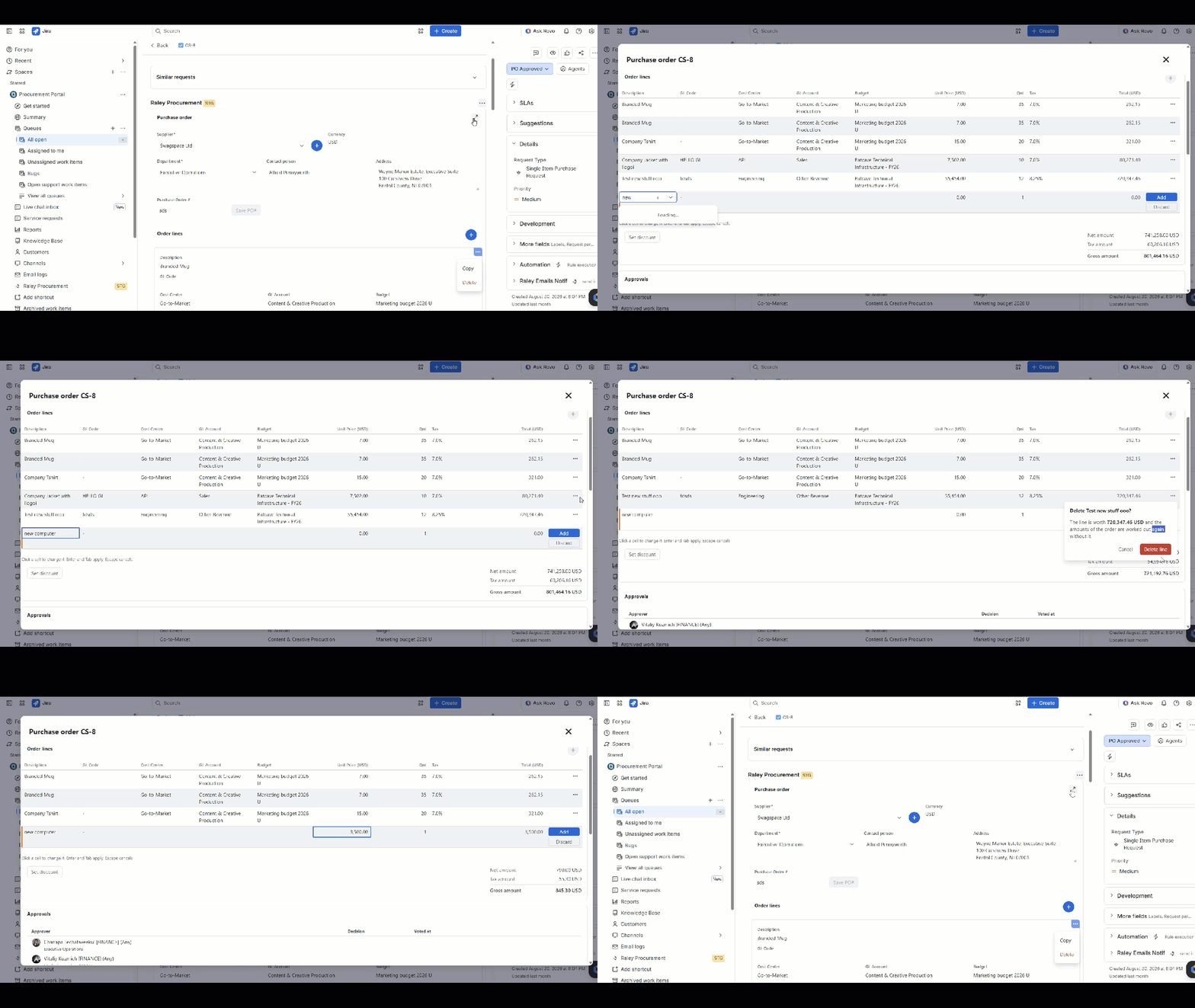
Raley Procurement for Jira and JSM turns a request from the JSM portal into a purchase order. It creates the order in the same Jira work item. It routes the order through up to three approval tiers. Approvals depend on department and spend limits. It generates a formatted PDF for the supplier. It also tracks orders and deliveries from the same issue. It includes partial receipts. Finance can view committed spend, which means approved orders not yet received. It is shown separately from actual spend in Jira dashboard widgets and CSV exports. It imports up to 1,000 products from a CSV. It handles purchase orders in multiple currencies. It also offers a REST API for hand-off to your ERP. It carries Atlassian's Cloud Fortified trust mark.7
Now the part a product page usually hides. It is not a source-to-pay suite, and it does not pretend to be. Strategic sourcing events, contract lifecycle management, and global multi-entity consolidation are jobs for an enterprise platform; if those run your week, buy one. It does not replace your ERP or your accounts-payable stack; it hands off cleanly after approval. And its whole advantage rests on your team already living in Jira. If you are not on Atlassian, one of the other five kinds fits you better, and we would rather tell you that here than sell you the wrong thing.
So the sequence is simple. Diagnose your sorest spot. Weight the region filter. Check what you already own before you buy a new anything. If that stack turns out to be Jira or JSM, try Raley Procurement against your own approval tiers and budget, not a canned demo, and see whether purchasing was a home-improvement job all along rather than a house move.
See Raley Procurement for Jira and JSM on the Atlassian Marketplace or read the full feature breakdown on the product page.
Questions people actually ask
What counts as mid-market for procurement software? Most vendors and analysts treat mid-market as roughly 100 to 1,000 employees, or about $10M to $250M in revenue. The sharper test is complexity: several entities, multiple approval tiers, and spend scattered across teams, but without the dedicated procurement department and nine-figure spend that justify an enterprise suite.
What is the difference between procure-to-pay and source-to-pay? Procure-to-pay covers the transactional flow from requisition to payment. Source-to-pay adds the strategic front end: sourcing suppliers, running competitive events, and managing contracts. Most mid-sized companies need procure-to-pay plus light sourcing, not a full source-to-pay suite.
How much does mid-market procurement software cost? It ranges widely. Purpose-built mid-market tools start from a few hundred dollars a month, with Precoro listing from about $499 and Tradogram from about $225, into the low tens of thousands a year. Enterprise source-to-pay suites are quote-based and typically run from tens of thousands into six and seven figures once implementation is counted (third-party benchmarks, as of 2026, not vendor list prices).
How is buying procurement software different in Europe versus the US? The biggest difference is e-invoicing law. The EU's ViDA reform and national mandates in Germany, France, Belgium, Poland, Italy, and Spain are phasing in mandatory structured e-invoicing between 2025 and the early 2030s, so European buyers must confirm support for formats like Peppol, Factur-X, and XRechnung, plus GDPR data residency and SEPA payment rails. US buyers face lighter regulation and choose mainly on ERP fit.
What is committed spend, and why does it matter? Committed spend is money already promised to a supplier through an approved purchase order, whether or not the invoice has landed. Tools that show committed spend separately from paid spend prevent the quarter-close surprise where approved orders were never counted against the budget.
Can you run procurement inside Jira? Yes. With an app such as Raley Procurement for Jira and JSM, a team already on Atlassian can raise requests in the JSM portal, route multi-tier approvals, generate PDF purchase orders, and track committed spend, all inside the Jira work items they already use.
How should I compare procurement tools without drowning in feature lists? Start with your sorest pain, not a grid. Identify which of the four core jobs is actually failing, apply the region filter, then shortlist the two or three tools built for that job and test each with your own real approval scenario and messy invoice. Ask every vendor for the first-year total including implementation, and for references at your size and on your ERP.
What we pulled together to write this
This guide combines findings from three independent research reviews from 2025 to 2026. It covers the mid-market procurement software market in the US and Europe. The results were checked against official product documentation. Sources are numbered below, and the superscripts in the text point to them.
- Market sizing: Mordor Intelligence, Grand View Research, and Fortune Business Insights, 2025 estimates. About $9 billion to $10 billion in 2025, Europe roughly a quarter. Figures vary by scope and method.
- Pricing benchmarks: third-party sources such as Vendr for quote-only vendors, 2026. Order of magnitude only, not vendor list prices.
- Vendor list pricing: Precoro from about $499 a month and Tradogram from about $225 a month, 2026.
- Analyst guidance: Gartner, Magic Quadrant for Source-to-Pay Suites, 2025, and its forecast on agentic AI in supply-chain and procurement software, January 2026. Spend Matters, part of The Hackett Group, SolutionMap, 2025.
- EU e-invoicing: European Commission, VAT in the Digital Age, ViDA, in force 2025. Mandatory intra-EU business-to-business structured e-invoicing from 2030.
- National e-invoicing mandates: tax-authority guidance for Germany, France, Belgium, Poland, Italy, and Spain. Formats include Factur-X, XRechnung, Peppol, KSeF, and FatturaPA. As of 2026.
- First-party product facts: RaleyApps product documentation and the Atlassian Marketplace listing for Raley Procurement for Jira and JSM.
A note on method, because you deserve it. Pricing in this market is mostly private. Review scores change month to month. We read G2, Capterra, and Gartner Peer Insights for direction, not scores. Analyst rankings use an enterprise view that may not fit mid-sized buyers. We have flagged uncertainty rather than papered over it. Treat every number here as directional and verify anything you are about to spend real money on.
Related reading:
![Vladimir [RaleyApps]](https://storage.ghost.io/c/54/bc/54bce786-a3c0-4ea3-b0f4-96f64229d4ff/content/images/size/w300/2026/02/Vlad-9-1-1.jpg)