![Vladimir [RaleyApps]](https://storage.ghost.io/c/54/bc/54bce786-a3c0-4ea3-b0f4-96f64229d4ff/content/images/size/w150/2026/02/Vlad-9-1-1.jpg)
Nothing stops when indirect procurement fails. The laptops still arrive. The agency still ships the campaign. The SaaS licence renews at 3 a.m. and the finance team finds out on the card statement. That silence is the whole problem: in The Hackett Group's Maverick Spend Report, companies estimated that as much as 16% of their negotiated savings disappear when people buy outside the process. Almost all of that buying is indirect, because direct purchasing has a forecast and a binding contract behind it.
This article explains what indirect procurement covers, why it leaks money in a way direct procurement does not, and what a team that is not a Fortune 500 can actually do about it.
The short answer
Indirect procurement is the buying of everything a company needs to operate that does not go directly into the product it sells: software, contractors, agencies, office and facilities supplies, travel, equipment, and professional services to name a few. It is booked as operating expense, requested by almost every department, and spread across hundreds of suppliers. Direct procurement, by contrast, buys the materials and components that become the product, and is usually run by a dedicated team with appropriate forecasting and tracking.
That spread is why indirect procurement is hard. Nobody owns all of it, so nobody sees the whole picture.
Already on Jira or JSM? Your indirect purchasing can run where your requests already live: Raley Procurement handles intake, approvals, and POs inside the tools you have.
Direct vs indirect procurement
Direct procurement buys what you sell. Indirect procurement buys what you run on. The two look similar on an invoice and behave completely differently in practice.
| Direct procurement | Indirect procurement | |
|---|---|---|
| What it buys | Raw materials, components, goods for resale | Software, services, equipment, supplies, travel |
| Where it books | Cost of goods sold | Operating expense |
| Who requests it | Production planning, from a forecast | Any department, when a need appears |
| Supplier base | Concentrated, contracted, relationship-driven | Fragmented, hundreds of vendors, many one-off |
| What happens when it fails | The line stops, and everyone notices | Nothing visible stops, and nobody notices |
| Share of spend | Dominant in manufacturing | 15% to 40% of total spend in most companies, higher in services and software |
The last two rows explain everything else in this article. A direct procurement failure has a forcing function: a missing part halts production and gets fixed (or noticed, at least) the same day. An indirect procurement failure has none. The purchase happens anyway, just at a worse price, from an unvetted vendor, without a record.
Why indirect spend leaks
Indirect spend leaks because the process to buy correctly is slower than the process to buy badly. Three mechanisms do most of the damage.
Maverick spend
Maverick spend is buying outside the agreed process or contract: the manager who expenses a tool on a card, the team that signs a contractor on a handshake, the department that renews with the incumbent because the intake form takes too long. It is rarely malicious. It is usually a rational response to friction.
The cost is not abstract. Hackett's benchmark of digital world-class procurement organisations found they suffer 59% less savings loss due to maverick spend than their peers. The gap between the two groups is mostly process, not headcount.
Tail spend
Tail spend is the long list of small purchases from many vendors. Hackett's 2025 Tail Spend Management Study puts it at roughly 20% of enterprise spend spread across 80% of suppliers, and found that only 4% of companies actively manage most of it. Each purchase is too small to negotiate. Together they are a large, unmanaged number.
For a 200-person company the tail is not exotic. It is the fourteen SaaS tools nobody reconciled, the three freelance designers on three different rates, and the office supplies ordered from whichever shop was open.
Spend that never becomes a purchase order
The quietest leak is the purchase that skips the PO entirely. No PO means no approval trail, no committed-spend number for finance, and no document to match the invoice against. The invoice arrives, someone recognises the vendor name, and it gets paid. Sievo's analysis of $103 billion in spend found that moving indirect invoice-to-due timing from bottom quartile to top quartile alone frees roughly $34,000 in working capital per $1 million of spend. You cannot manage timing on invoices that have no order behind them.
What indirect procurement covers
Indirect procurement covers every operating purchase, and each category leaks in its own way. Five categories account for most of the spend in a software or services company.
Software and cloud. The fastest-growing category and the one with the most auto-renewals. The failure mode is sprawl: duplicate tools, unused seats, and multi-year clauses nobody read.
Contractors and professional services. Consultants, freelancers, legal, audit. The failure mode is scope: statements of work that describe outcomes vaguely enough that every invoice is technically correct.
Marketing and agencies. Media, creative, PR. The failure mode is opacity. The Association of National Advertisers found that about one in four dollars in the $88 billion open-web programmatic market is lost to waste in the supply chain.
Facilities, equipment, and supplies. Laptops, furniture, maintenance, consumables. The failure mode is urgency: someone needs it today, so the process gets skipped altogether.
Travel and events. The failure mode is off-channel booking, where the price you negotiated never gets billed.
You do not need a category manager for each of these. You need each of them to enter through the same door.
The Indirect Spend Control Ladder
The Indirect Spend Control Ladder is a four-rung test for how much of your indirect spend you actually control. Most teams are on rung one and think they are on rung three. Climb it in order; each rung depends on the one below.
Rung 1: one front door. Every indirect purchase request, from any department, starts in one place with a structured form. If requests arrive by email, chat, and hallway, you are not on the ladder yet. This is the rung that kills maverick spend, and it only works if the door is easier to use than the workaround.
Rung 2: no PO, no pay. A purchase order is issued before the commitment, not reconstructed after the invoice. Approval routes by the rules you already have (department, CC, GL, product type, spend threshold) so a $200 cable clears in one step and a $40,000 contract collects every sign-off. The benchmark above suggests this is where world-class teams pull away.
Rung 3: receipt before payment. Someone records that the goods or services arrived, per line, and the invoice is matched against both the order and the receipt. Partial deliveries get partial receipts. This is the rung that stops paying for things that never showed up.
Rung 4: spend you can query. Committed and received spend is visible by department, supplier, and cost-center while it happens, not at quarter close. Until this rung, "how much do we spend on contractors?" is a research project.
A useful benchmark for where you land: Hackett's world-class organisations run about 95% of indirect spend under management, against 66.5% for everyone else. If you cannot state your own number, you are below rung four by definition.
How company size changes the answer
Company size changes the tooling, not the ladder. The four rungs are the same at 50 people and 5,000; what differs is how much machinery you need to climb them.
Below about 50 people, a shared form and a spreadsheet can hold rungs one and two if one person owns it. Past that point the spreadsheet becomes the bottleneck, and the honest options split three ways: a standalone procurement platform, a module of a larger finance suite, or a purchasing layer inside a request tool your company already runs. We compare those paths in what cloud-based procurement software does and when you do not need it and, for the 100-to-1,000 range, in the mid-market procurement software buyer's guide.
The third path matters more for indirect than for direct procurement. Indirect requests come from every department, and every department already raises IT, HR, and facilities requests somewhere. If that somewhere is Jira Service Management, the front door for rung one already exists. The case for it is in why procurement belongs in Jira Service Management.
Features to check, whichever path you take
Whatever you choose, six capabilities decide whether you climb the ladder or buy a nicer spreadsheet.
- A structured request form you can extend with your own required fields (cost centre, project code, need-by date), so you can't submit a half-empty request.
- Approval routing by threshold and department, in stages, with each approver seeing only what concerns them.
- A generated purchase order (usually a PDF) issued from the approved request, not typed separately.
- A supplier and product catalogue, so recurring purchases are picked, not re-described.
- Goods receipt recorded per order line, with partial receipts.
- Committed-spend visibility and an export finance can reconcile against.
Anything beyond these is useful for large procurement functions and optional for everyone else.
Where Raley Procurement fits
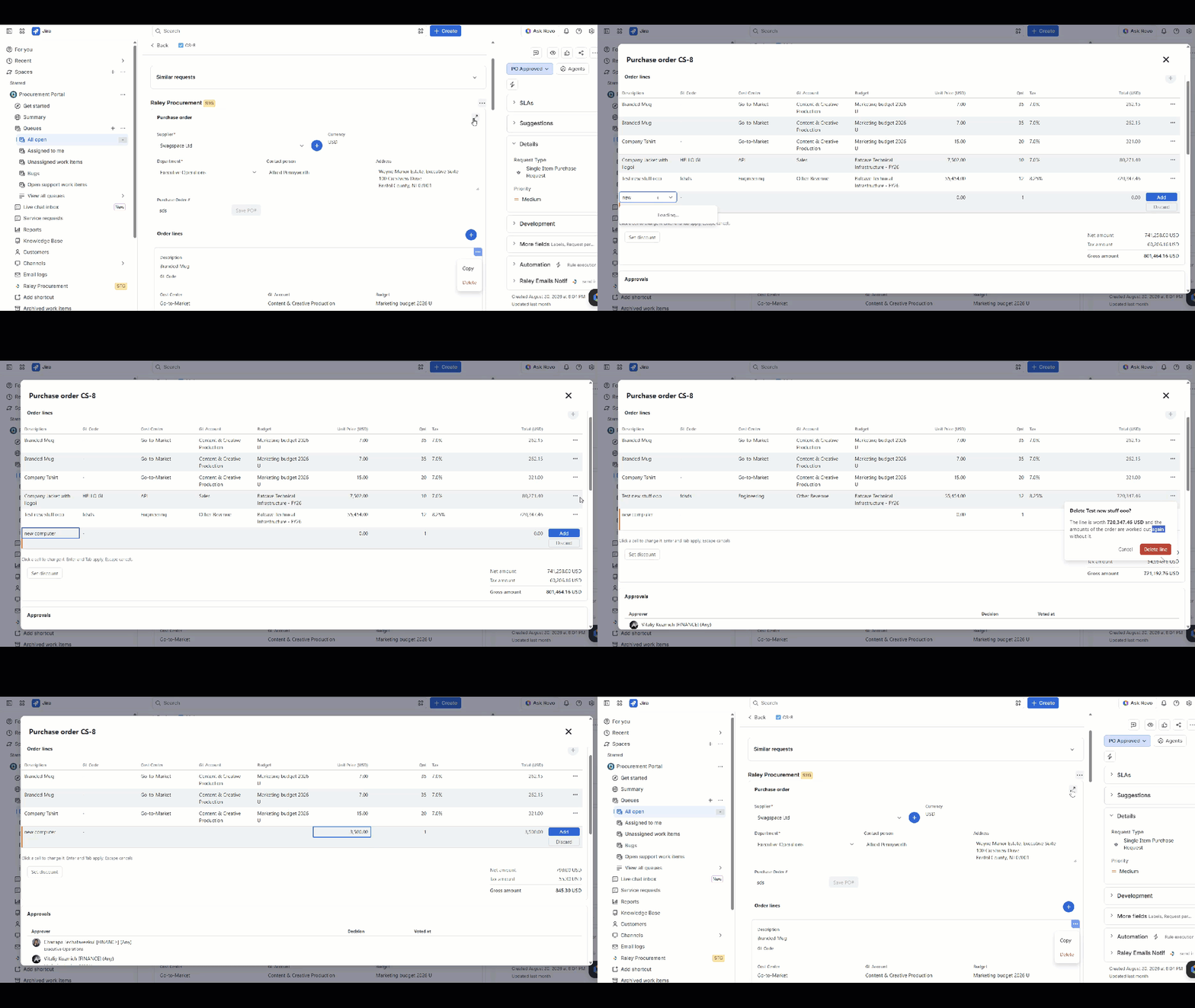
We build Raley Procurement for Jira & JSM, so read this section knowing that. It runs the six capabilities above inside a Jira or JSM work item: purchase requests raised through the JSM portal with your own required fields, approval routing by department, cost-center, gl account, product type, and spend threshold, a PDF purchase order generated from the approved request, a supplier and product catalogue with CSV import, goods receipts per order line with partial receipts, committed-spend dashboards, and CSV or REST export. It is Cloud Fortified on the Atlassian Marketplace.
It is not a source-to-pay suite. It does not negotiate with suppliers, manage contracts or supplier risk, or replace category management for a procurement department of twenty. If your indirect spend runs into the hundreds of millions, you are shopping in a different aisle, and the buyer's guide above says so.
Where indirect procurement is headed
Indirect procurement is moving toward orchestration: one intake layer that collects every request and coordinates the reviews behind it, with software increasingly handling the small negotiations humans never got to. Hackett reports that 88% of procurement leaders are open to AI-powered agents for small-value negotiations. That is a sensible direction for the tail.
It does not change the ladder. An agent negotiating a $12,000 renewal still needs the request to have entered through one door, a PO to exist, and a receipt to close it. The rungs come first. The automation sits on top.
How to decide, in practice
Start by counting doors. List every way an indirect purchase request reaches an approver in your company today: email, chat, a form, a spreadsheet, a conversation. If the answer is more than one, that is your first project, before any tool comparison.
Then ask which rung you are on and be honest about it. Most teams discover they issue POs for some purchases and none for the rest, which means rung two is a habit, not a control.
If your company already runs Jira or Jira Service Management, the front door exists and your indirect procurement can live in it. See how Raley Procurement runs intake, approvals, and purchase orders inside JSM, and start a free trial from the Marketplace.
FAQ
Short answers to the questions people search for around indirect procurement.
What is indirect procurement?
Indirect procurement is the purchase of goods and services a company needs to operate but does not sell: software, contractors, agencies, facilities, equipment, supplies, and travel. It is booked as operating expense and requested by every department, which is why it is harder to see and control than direct procurement.
What is the difference between direct and indirect procurement?
Direct procurement buys what goes into the product (materials, components, goods for resale) and is planned from a forecast by a dedicated team. Indirect procurement buys what the company runs on, arrives from any department without a forecast, and involves a far more fragmented supplier base. When direct procurement fails, production stops; when indirect procurement fails, nothing visible stops, so the cost accumulates quietly.
What are examples of indirect procurement?
SaaS subscriptions and cloud services, freelance and consulting contracts, marketing agencies and media, laptops and office equipment, maintenance and cleaning, office supplies, and business travel are all indirect procurement.
What is maverick spend in indirect procurement?
Maverick spend is buying outside the agreed process or contract, usually because the official route is slower than the workaround. It removes the purchase from approval, from negotiated pricing, and from the record. The fix is to make the correct route the easy one: a single intake door and approvals that route automatically.
What is tail spend?
Tail spend is the large number of small purchases from many suppliers that are too small to negotiate individually. Hackett's 2025 study puts it at about 20% of spend across 80% of suppliers, with only 4% of companies actively managing most of it.
Can indirect procurement run inside Jira or Jira Service Management?
Yes. Indirect procurement is a request-and-approval workflow, and JSM is a request-and-approval engine most companies already use for IT and HR. A Marketplace app such as Raley Procurement turns a JSM request into a purchase request, routes the approval tiers, generates the PO, and records receipt, all inside the work item.
Related reading
- What is cloud-based procurement software?
- Why procurement belongs in Jira Service Management
- Solving the intake-to-procure problem with Jira Service Management
- The benefits of automating your purchasing process
- Mid-market procurement software: a buyer's guide
- Procurement in Jira: 8 lessons from five years in the field
![Vladimir [RaleyApps]](https://storage.ghost.io/c/54/bc/54bce786-a3c0-4ea3-b0f4-96f64229d4ff/content/images/size/w300/2026/02/Vlad-9-1-1.jpg)